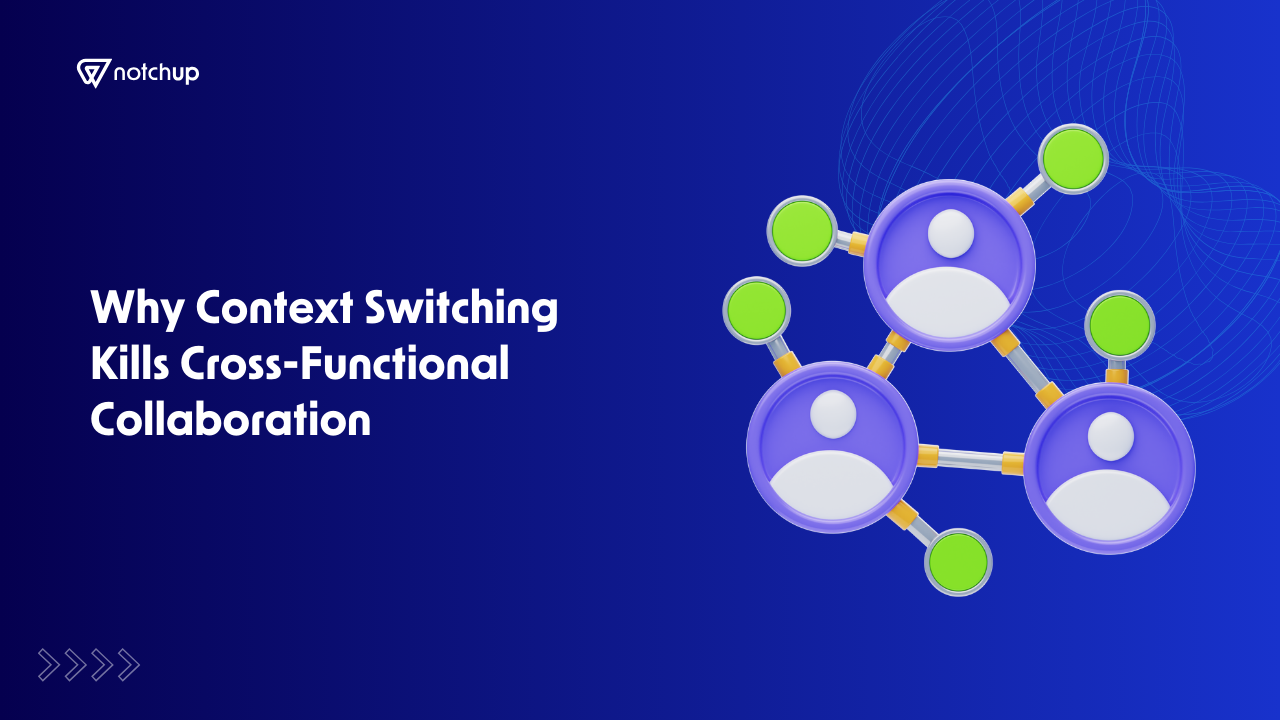
Cross-functional squads are supposed to accelerate delivery by bringing product, engineering, design and data together. In practice, many squads feel stuck in molasses. Work advances in micro-steps between long pauses, decisions keep getting re-opened and nobody has a clear mental model of the whole. A major, often invisible culprit is context switching.
Context switching is not just an engineering productivity issue; it’s a collaboration killer. When every member of a squad is juggling multiple projects, domains and stakeholder groups, the team never shares the same mental context at the same time. The cost shows up as:
The illusion is that more parallel work equals more output. In reality, the overhead of constant realignment eats the gains.
Each cross-functional role already has a tall stack of tools and responsibilities. Engineers jump between IDEs, CI dashboards, ticket boards and logs. Designers juggle Figma files, research repositories and design systems. PMs live in roadmaps, CRMs and analytics tools. Layer on multiple projects per person and the cognitive tax skyrockets.
Every context switch forces the brain to rebuild a mental model: “Which customer segment is this? Which constraints apply here? Who owns this piece?” That rebuild time is lost collaboration time.
As an engineering manager, look for patterns like:
These are not just scheduling problems; they are signs that cognitive load is too fragmented for the team to operate as a cohesive unit.
Cross-functional work demands shared context for good decisions: user goals, constraints, dependencies, risks and trade-offs. If only one person at a time holds that full picture, collaboration degenerates into hand-offs and approvals.
Consider a simple feature: pricing tweaks for a new segment. Product, design, engineering, marketing and finance each view it through different lenses. If they only interact via scattered meetings while juggling other initiatives, every conversation starts at slide one. The team never reaches the depth needed for creative collaboration.
A classic agile recommendation is to limit work in progress (WIP). For cross-functional teams, EMs should enforce WIP limits at the squad level:
When everyone’s attention is anchored in the same 1–2 initiatives, collaboration quality improves dramatically. Discussions become richer, decisions stick and the team gains a shared vocabulary.
Stand-ups and sprint ceremonies alone do not ensure shared context. As an EM, co-design rituals with your PM and design partners that:
The goal is fewer, higher-quality interactions instead of shallow interruptions.
Hidden work is a major source of context switching. If an engineer does not know that design is blocked on research, they may start something else, fragmenting focus further. To avoid this:
When everyone sees the same picture, the team can make joint decisions on where to focus and what to defer.
Some collaboration steps benefit from doing work in sequence rather than parallel. As an EM, push back on patterns like:
Instead, consider:
This reduces cognitive thrash and keeps the team’s story straight.
Even with good squad habits, the broader organisation can inject context switching through urgent asks, exec escalations and multiple “must-win” projects. As an EM:
Saying “no for now” is essential to protecting collaborative effectiveness.
Treat context switching as a measurable problem:
Then run experiments: lower WIP, consolidate meetings, adjust rituals. Measure improvements in lead time, quality and team satisfaction. Over time, collaboration begins to feel like flow rather than friction.


.svg)


.png)
.png)